
The Global Semiconductor Supply Chain and the Philippine IC Design Ecosystem
Semiconductors are the backbone of modern technology. From the smartphone in your pocket to electric vehicles and the AI systems reshaping industries, none of this exists without microchips. As global demand reaches unprecedented levels, the question is no longer just how chips are made, but where countries like the Philippines can strategically compete in this high-stakes arena.
This article analyzes the end-to-end semiconductor supply chain and evaluates the Philippines’ current position, arguing that a strategic pivot toward IC design is not merely aspirational—it is imperative.
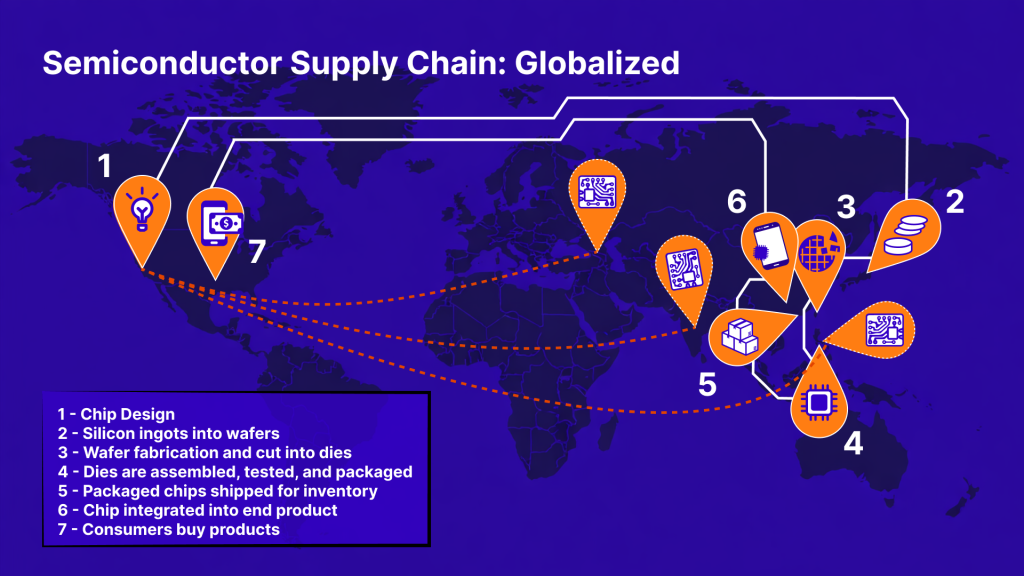
The Global Semiconductor Supply Chain
The semiconductor supply chain is one of the most intricate industrial systems ever developed. A single chip may cross multiple international borders before reaching its final form. No country controls the entire process; instead, the world has embraced hyper-specialization.
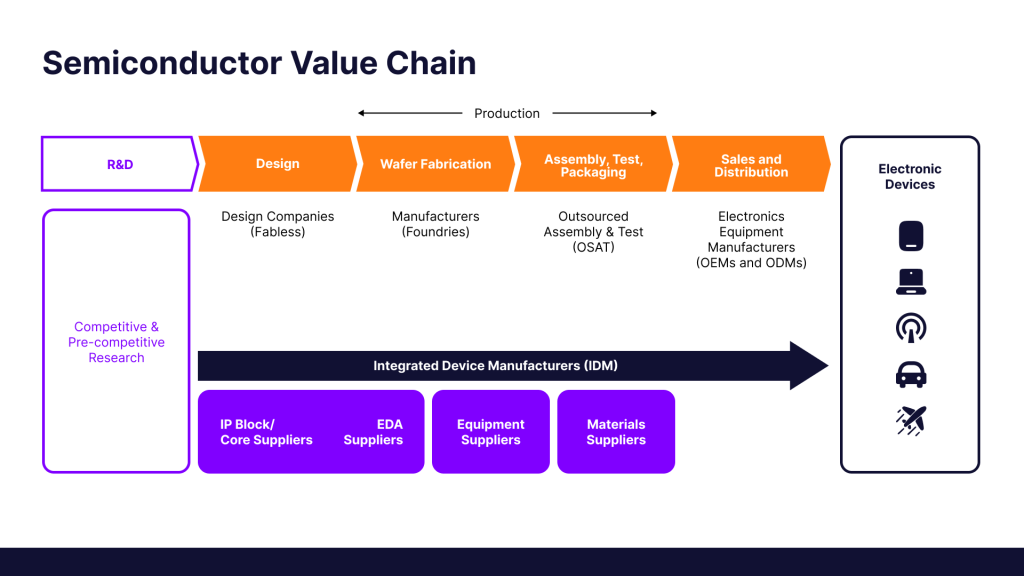
The workflow is divided into three primary segments: IC design, front-end fabrication, and back-end assembly and test (OSAT). Each stage is both capital- and talent-intensive. Even minor disruptions—such as a drought in Taiwan or a shipping bottleneck in Shanghai—can halt global production for months, underscoring the fragility of the system.
IC Design: The Intellectual Core
IC design is the intellectual engine of the semiconductor industry. Engineers translate complex functional requirements into circuit architectures, optimizing billions of transistors to balance power, heat, and performance within microscopic constraints.
While leading U.S. and European companies often retain ownership of design blueprints, the actual work of physical design and verification is increasingly global. This segment is high-value and talent-driven: it requires specialized expertise, not multi-billion-dollar fabs. For the Philippines, which produces a large pool of adaptable engineering talent, IC design represents the clearest path to capturing higher margins and creating meaningful intellectual property.
Wafer Fabrication: The Infrastructure Challenge
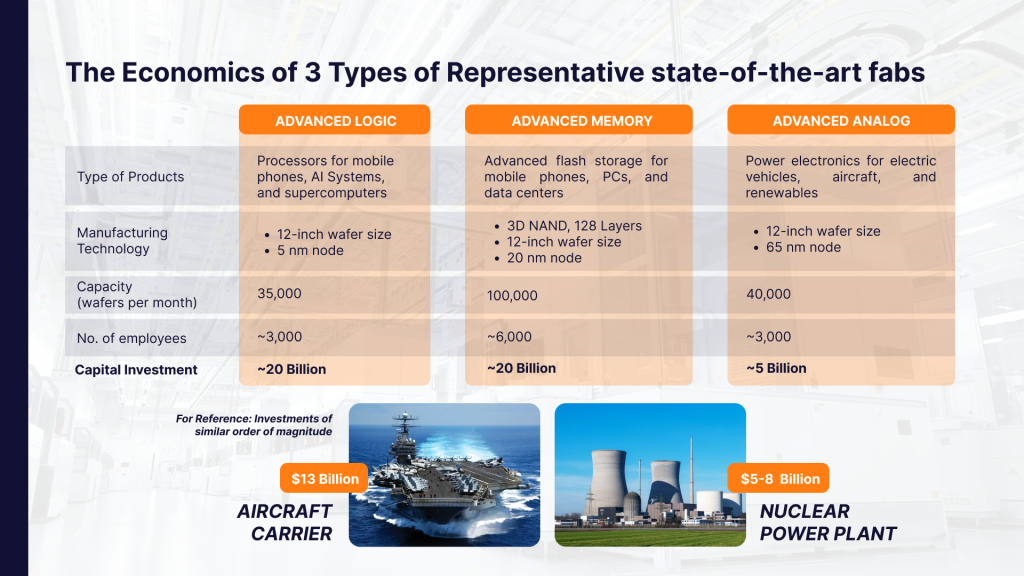
Front-end fabrication—the process of printing designs onto silicon wafers—is the most capital-intensive segment of the chain. Leading-edge fabs cost over $20 billion and demand stable electricity and ultra-pure water.
For the Philippines, constructing 5nm or 3nm fabs remains impractical due to high energy costs and infrastructure limitations. Nevertheless, mature-node fabrication for automotive, industrial, and IoT applications provides a feasible, though still expensive, entry point for regional players.
OSAT: The Philippines’ Established Strength
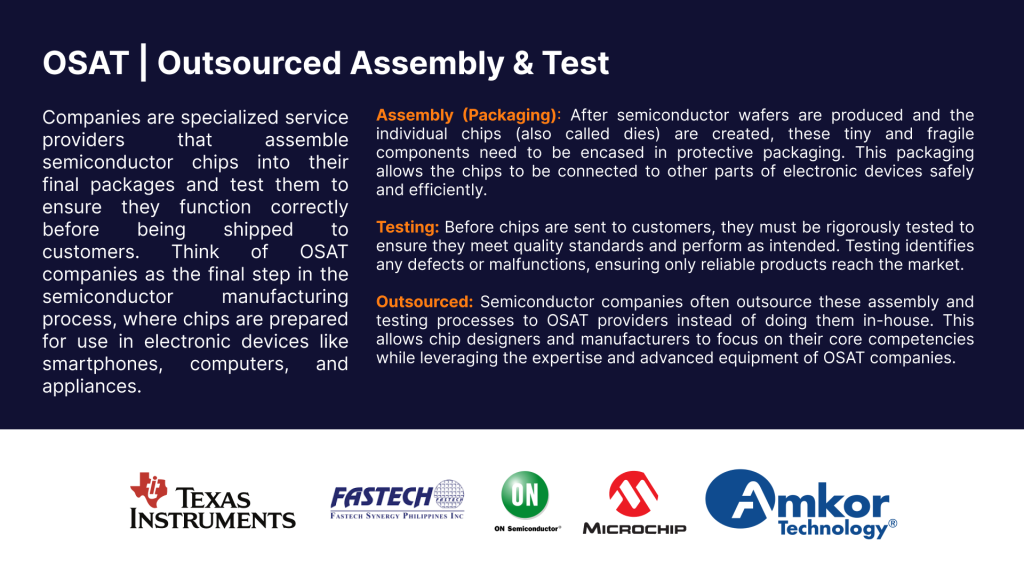
Back-end OSAT involves wafer dicing, packaging, and rigorous testing to ensure product reliability. Here, the Philippines has excelled for decades. Large-scale operations from companies like Texas Instruments, STMicroelectronics, and Amkor have positioned the country as a global hub for assembly and test.
While OSAT is a high-volume, lower-margin business compared to upstream activities, it forms the backbone of the nation’s electronics exports. This entrenched expertise provides leverage for a strategic move up the value chain.
Geopolitical Context: The “China + 1” Imperative
Semiconductors have become a matter of national security. Rising U.S.-China tensions have compelled multinational firms to diversify production—a strategy known as “China + 1.” Southeast Asia is the immediate beneficiary, with countries like Vietnam, Malaysia, and the Philippines vying to become more than stopover points in global supply chains.
For the Philippines, demonstrating reliability, talent depth, and strategic foresight is critical to securing long-term partnerships in this so-called “Silicon Renaissance.”
Strategic Pivot: Moving Toward IC Design
Philippine industry growth requires moving up the value chain. Large-scale fabrication may be out of reach, but IC design leverages the nation’s greatest asset: its people.
Focusing on design and R&D can create higher-paying roles, foster domestic intellectual property, and enhance the attractiveness of existing OSAT operations. The shift is not merely economic—it is strategic. Transitioning from chip assemblers to chip architects positions the Philippines as a high-value contributor rather than a peripheral participant.
Addressing the Talent Gap
The most pressing barrier is not a lack of talent, but brain drain. Although the country produces over 80,000 engineers annually, many seek better opportunities abroad.
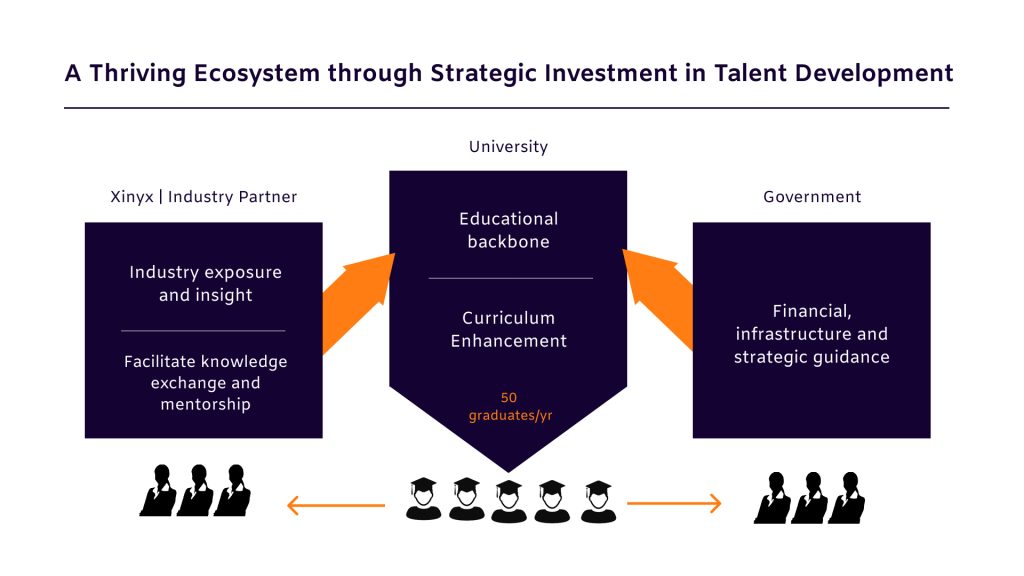
Bridging this gap requires a tripartite approach:
Academe: Updating curricula to include hardware description languages (Verilog, VHDL) and FPGA prototyping.
Industry: Establishing lab-scale facilities for local prototyping and R&D.
Government: Incentivizing design firms through frameworks like the CREATE MORE Act.
Without coordinated action, the Philippines risks losing not just talent, but influence in a rapidly consolidating industry.
Looking Ahead
The global semiconductor supply chain depends on collaboration, specialization, and long-term investment. No single country can dominate every stage, but each can choose where it creates the most value.
For the Philippines, focusing on IC design offers a realistic and strategic path forward. By investing in talent, strengthening industry–academe partnerships, and building on existing strengths, the country can play a larger role in shaping the technologies that will define the next generation of electronics.
Author/Speaker

An Christine Gojar
Corporate Communications Executive